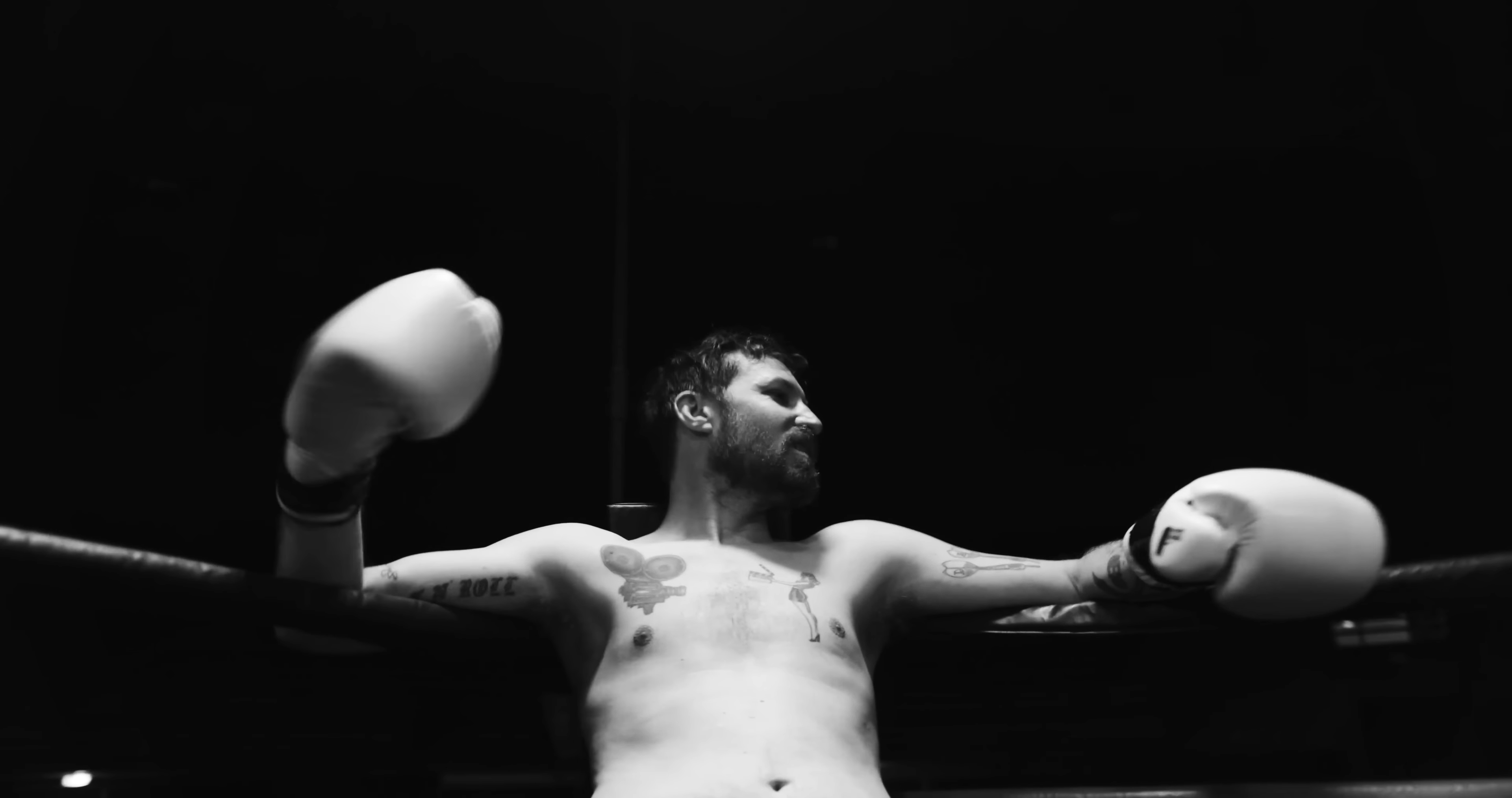
This boxing feature escapes its low-budget by the use of real crowds and actual fighters to fill the world of the “Tough Man” competition. J-Bob is a ex-champion caught up in a multi-level marketing scam (which he insists is not a pyramid scheme) who joins the fight for money, much to the opposition of his family played by boxers Trae Strout and champion Christy - The Coal Miner’s Daughter - Martin.
My first question was about how your prior involvement in this kind of world of boxing contributed to the film.
Yeah, so I have been doing documentary work, photography, and film in sort of the world of boxing and Appalachia for almost a decade now. I think I first went in shots with some of my main subjects from my feature documentary, Country Brawlers, which should be available to stream very soon, about 2016, 2017. Since then, I’ve made a feature documentary, I’ve done some photo essays, and then this fiction film.
It’s just a really rich world full of really interesting characters, very DIY, and there’s not a whole lot of boxers in the region that are going to be on HBO or ESPN or be in the big fights, but there are other people who basically become hometown heroes but also have an opportunity to fight in those big fights. Some of the boxers in the region actually fight potential world champions or people who are kind on their way up in their career, using them almost as like training ground. So the documentary was really centred around that aspect. And then with any documentary, you shoot so much footage, you meet so many characters, you have so many different things that you’d love to film more of, but you just can’t fit in the film.
And the Tough Man competition, which is featured in Beat Down, was one of those. And so I really wanted to set a fiction film around that event and so my writing partner and I, John Temple, we decided to set a whole fiction film within the world of Tough Man.
Using the actual Tough Man event gives so much to the film but what was the process of shooting and what do you think it added and maybe some complications that it brought?
So when we were thinking about shooting at Tough Man, we realized it would be difficult because it is a live event. It happens over two nights and they do about seven or eight cities a year. But obviously they change locations. And so we knew we had to shoot it all in two nights, one Friday night and one Saturday night. And then if we’re going to centre the whole film around that event, obviously it’s not going to be a bunch of scenes that lead up to the event, then just the events and then scenes afterwards. The events would actually be sprinkled in and throughout the film. So that one of the challenges with that was we had to shoot the film non-linearly and with a very low budget, it’s just a little more complex. We didn’t have production designers and continuity people so we had to keep track of wardrobe and all those things ourselves.
So that was one complication. And then a second obviously is just filming in a live event, right? So you have actual boxing matches going on. They do about 70 or 80 per night, three one minute rounds. There’s 4,000 people in the audience and then we’re trying to film a feature film sort of within the midst of all that. And so a lot of that is just running around and getting shots when the music’s not blaring, trying to shoot a quick five minute scene of someone talking on the phone or a conversation.
But the creator of Tough Man, Jerry Thomas, who I’ve known for a few years now, he’s great and he always loves when I show up and shoot film or photos. And so he gave us 10 minutes of intermission on each night to film our scenes in the ring. So they usually have a 10, 15 minute intermission, about half way through the event. So we got in the rin and they kept the lights down for us to keep it more dramatic. And then we actually shot our scenes, our four main boxing scenes in those 30 minutes, basically, which is kind of insane. Very rushed, but also kind of really exciting and you know, the crowd was into it. So that part was a lot of fun. But other than that, I think what it adds to the film is that it gives it so much more life, right? I mean, for micro budget films or very low budget films, the sort of common refrain is “Okay, get three characters, put them in a house, write a script” right? Like that’s your whole canvas. Whereas in our film, it’s a lot of different locations. It’s across West Virginia. And then the centrepiece is this 4,000 extras basically in a live event. And so it makes the world feel really big, it makes the film feel larger than it actually is.
And one interesting thing I thought about the narrative was the fact that the story takes place over I think it’s only three days something like that. What was the decision behind that because obviously in boxing films especially you always have these kind of training montages over months.
Yeah. In three days, yeah you can’t get all that much fitter for a training montage. We wanted to keep the narrative contained within sort of that weekend. We, we stretched it out over three days just to give us a little more ups and downs in the drama.
We also just really liked the idea of honing in on our main character, J-Bob’s dramatic moment, right? His whole life, he’s thought of himself as sort of a big shot. He’s always acted like a big shot, but at the end of the day, he always come up short and is a little bit of a near-do-gooder. So seeing him at sort of this inflection point of him having to come to terms with the fact that maybe he’s not actually a big shot, maybe him always trying to do the big thing or be the big shot is actually detrimental to his life and to his happiness and to his relationship with his family.
And in a lot of action scenes filmmakers use handheld cameras but it’s kind of used throughout the film here. What was the decision behind that?
I’m a documentary filmmaker. I’ve made some fiction shorts, but I really wanted to showcase my cinematography in a fiction film because I really do enjoy filming fiction. But you know, if you’re shooting a lot of documentary, then it’s hard to get jobs in different arenas. So that was really one point of actually making the film. But what I realized was, as you co-write, direct, produce, location scout ...do all these other jobs, which I was doing because we are on such a low budget, often that we would get too close to time to shoot a scene. And I hadn’t really thought all that much about how I was going to shoot it. And so in one way, I sort of fell back on what I know and what I do best, which is sort of documentary capture.
The handheld camera work I think really lended itself well to actually showcasing sort of the feeling that we’re trying to get across on screen. And so yes, in the boxing scenes it works well for sort of all those action sequences, but also I think in the day-to-day world of J-Bob and his family, it works well as well, because it shows sort of that visceral experience that he’s having throughout the movie.
And with that kind of natural documentary tone there’s also a lot of non-actors. In one of your videos you said “It was easier to train boxers how to act, than actors how to box” and that’s probably true. I was wondering what how was that process like for you?
Yeah, so because I had spent so much time in the world of Boxing and Appalachia, I knew there were quite a few colourful cast of characters that I would love to put in the film. And there are just some people that you realize are natural on camera. They’re natural being themselves. They’re not putting up a front. In documentary, you get pretty good at picking out the people who are putting up a facade or a shield and acting like a better version of themselves versus the people who are just acting like themselves. There’s a big difference there.
And so a lot of the people that are in the film are people I’ve met over the course of the last eight, nine years who I just realized are just naturally acting like themselves whether it’s Keith Barr, who’s the guy who works at the convenience store who J-Bob fights in his second fight, or all the other boxers that Trae fights, who’s J-Bob’s son. They’re all actual real professional boxers. Then Trae himself is a professional boxer, a young professional boxer.
The main character that is also a non-actor is J-Bob’s mum, who’s Christy Martin. When we were writing this script, it was actually a sort of father-son-grandson story. And then as we were writing the script, and a lot of the film is about J-Bob coming to terms with his shame and sort of his own embarrassment or his own shortcomings. And so we thought, would that be even more visceral and apparent if it was actually a mum-son-grandson story?
And once that clicked, we started thinking about different Appalachian actresses, but then we obviously remembered that one of the greatest female boxers of all time is from West Virginia, Christy Martin, Christy the coal miner’s daughter, Martin. And Elaine, my wife - who helped produce the film, and I just emailed her out of the blue. West Virginians are kind of always looking out for each other. We’re a small state, and there’s no film industry here, and really very few professional athletes as well. She was nice enough to do a screen test for us and instantly she has sort of that great charisma and a great vibe on set. And so once we had her in place and J-Bob, who’s played by an excellent actor, Linds Edwards, and then Trae.
Linds is such a talented actor, he’s very experienced. He’s been in a ton of TV shows and movies, he’s played small characters, big characters, and kind of everything in between. For a lot of the time, in between takes, he’d be the one who would be talking to Christy or Trae and go “Deliver the line, maybe it’s little more like this.” So it took a lot of pressure off me, who’s also the cinematographer, to have to be sort of be heavy-handed with the non-actors.
I think the best way to use actors is to have them do what they do best, right? It’s like my favourite scenes are when Christy Martin is telling stories about her time as a boxer or when she’s training Trae. Like that was actually a test shoot, a lot of the footage of her and Trae in the boxing ring was. And I was just like “Trae’s gonna do some shadow boxing and just watch him and give him some pointers.” And so there’s a lot of the funny lines and the things she says are just Christy being Christy.
Obviously boxing is kind of a whole genre of films and there are many great boxing films and even some independent ones .I was wondering where do you think your film fits within that kind of genre whether it’s like opposing it or what it adds.
I think so many boxing films, as you mentioned, are sort of that very similar story of maybe a down-on-his-luck person who finds boxing and then a lot of training montages, some losses, and then eventually, you know, fights their way up to the top, right?
And what I think is so interesting about this region is there’s people who have that trajectory but aren’t necessarily going for the Rocky moments or Creed where like the biggest boxer in the world, giant mansions, big cars, and I think boxing is often represented that way. But for a lot of people, boxing is just a way to have community and brotherhood and meaning and purpose, right? And I think that’s where this film is, I think, very different in that way. It’s that, you know...
The film is definitely more of like a family drama with boxing as like a vehicle to explore the themes. So it is a little different in that way as well. And all the punches are real, except for J-Bob’s. Anytime Trae fights with any of the other professional boxers, they’re just punching each other. Like they’re just sparring hard and actually hitting each other. We made sure J-Bob didn’t get punched because Linds obviously is not a professional boxer, but the rest are all real punches, which is fun.