
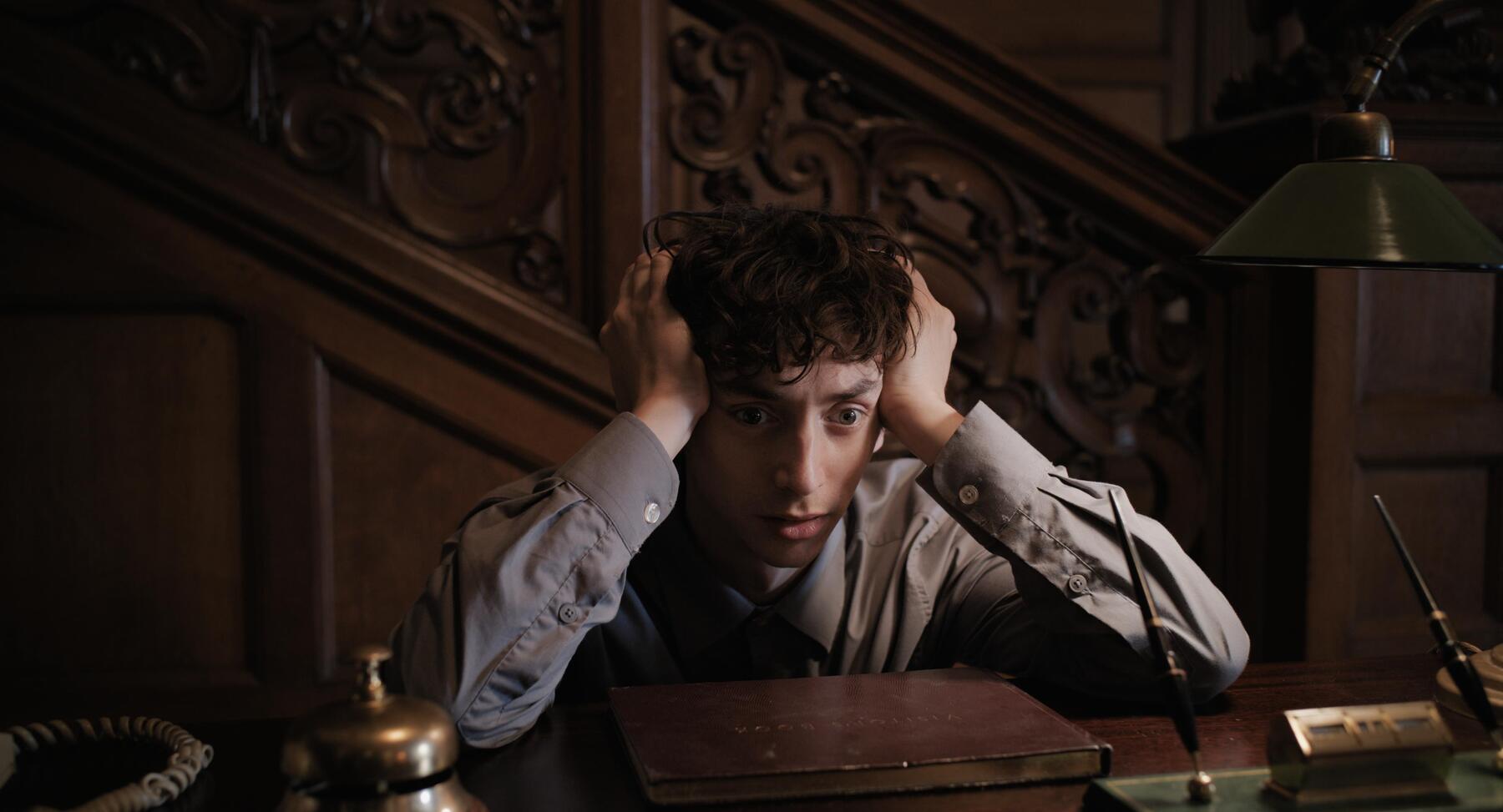
Courtesy of EIFF
Misper is a crime drama like no other. Primarily due to its unique perspective of looking at the impact of a missing person on a colleague that knew the victim, but also due to its slow psychological tension that does not settle. Through its portrayal of the media and sensationalism, it comments on the ethics of telling true crime stories.
I first wanted to ask the film about how a missing person story could have been set anywhere in the UK and unfortunately it does happen everywhere in the UK really. What was the decision behind the setting of a declining seaside town and inside of that a hotel?
Laurence:
Harry’s from Southport, so I that was part of the decision because originally we were going to set the film in Southport. But then because it’s about true crime and it’s about quite a dark subject matter, we didn’t want to kind of set it specifically in a real town because we didn’t want to tar any town with that brush. So I guess it was more of a want to feel like we could be creatively free, not being tied down to a certain town and hopefully it would reflect the whole of England rather than specific place.
Harry:
We liked the nebulous of it: you don’t quite know what year it is, you don’t know where it is. That’s why all the technology in the film is old technology. So it doesn’t feel like 2025. And then originally, the script was written to be in a shop. But thena a shop is really expensive. So then we changed it to a hotel and we’d already found this amazing hotel. And also I think with seaside towns, there’s something about them where during the off season they feel like they’re kind of dying, people don’t go here anymore - which I think worked well for the story.
And in similar kinds of films, the protagonist is normally either a detective or a really motivated investigator. Why was it very important to have a protagonist that was a bit socially awkward?
Harry:
We did start writing a TV script that was kind of a Harold and Maude, you know, and it was a girl in the shop and it was Pam and Leonard. And they worked in the shop together and they kind of became friends and we were at that point where it was like maybe there was gonna be a romantic thing. Then we threw that out as that feels quite done before.
But that started the conversation about the purpose of this true crime genre and what’s inappropriate. And we started talking about dramas on TV that felt like really inappropriate because they’re like Sudoku puzzles and there’s no emotions. And it’s all from a gruff police officer who’s got an alcohol problem and he goes home and he’s got a bad relationship with his wife. And just like very tropey. And then that’s what kicked us on.
What’s interesting about this is that it’s a new take. And we even wrote a script where the procedural stuff was still in it. And Lawrence contacted a script editor, who read it and said “you’re still doing the thing that you don’t want to do.”
I think we realised that the interesting thing to us wasn’t the police procedure itself. It wasn’t close family. It was seeing people who kind of knew her but didn’t know her and exploring what that would be like in reality. Because we see so many stories where they’re about the police and about the close family. We thought, well, what it would be like if your colleague went missing.
Laurence:
You felt like you knew them because you spent a lot of time at work but you didn’t really know them. All the news in it is all second hand sources. We don’t ever see anything to do with the crime and the violence is kept off screen which was again another decision we made quite early on. We just thought it would be more interesting to see what it would be like in reality for these people. These outsiders, I think that’s what we were always drawn to. I guess that’s why he was bit socially awkward because we thought we wanted everyone in the hotel to be a bit strange. I think we’re attracted to odd.
And there are these moments of inappropriate positivity, like a newspaper describing her as a girl next door type, or the karaoke scene. Why was it important to include those?
Laurence:
I guess we’re not laughing at the fact that we got missing in what happens later on, but we’re exploring how people react in these situations and that was funny to us and interesting because during really dark times, I think people do react in strange ways. People use humour to cope, but also people say very inappropriate things and that was very interesting to us, like these socially strange characters and how they deal with this really odd situation.
Gary [The Hotel’s Manager] is obviously good example of that, he’s really trying to keep the hotel alive and he’s saying these inappropriate things but it’s not from a bad place. He’s not equipped to cope with this situation at all.
Harry:
I think “the girl next door” I liked because it was about how media representation is a bit twisted and I think that’s what Leonard gets so caught up about that they didn’t know her. He obviously sort of didn’t know her, but he knew her better than those people. And so I think he is annoyed that they didn’t know her and they’ve just lumped her in this cliché. So I always love that moment.
And that stuff actually came from during our rehearsal process with Emily Carey, who’s brilliant in the film, and her talking about how Elle isn’t a girl next door, and then that line went into the film. It kind of goes back to your question before, it’s about seeing these true crimes in the way they’re sensationalised, and it was trying to do something that didn’t sensationalise this crime in any way, and tried to look at what it would actually feel like.
I like the soundscape of the film. Both the music and the more atmospheric elements but also the voicemail that keeps on playing. One of the most famous cases in the UK of media was the News of the World tapping the voicemail of a missing person. Did stories from the wider media influence the film?
Harry:
That’s a really good point. I’ve not made that connection but that is true. It just came out of intuition. A lot of what Lawrence and I do is we just go, what would actually happen? What is the real take on this? He would try and call her and then she wouldn’t answer and then suddenly you’ve got a voicemail and then you go ooh, voicemails are eerie, especially if the person is missing.
One thing we did mention was the Ian Huntley interview with Sky. That’s such an odd, strange interview. And we did actually have at one point in the film an interview with Gary outside the hotel where he was kind of promoting, they were doing like a 50 % off on rooms at the minute and stuff in honour of Elle’s death. And we said, “this is too inappropriate for Gary.”
I think we looked a lot of true crime and we tried to say, what’s the kind of real version of this? And it was this kind of slow and odd ominous drip feeding of information that takes a big toll on Leonard’s mental health during the film and then again that was what we wanted to explore it was how these people were affected by this rather than the actual crime and the portrayal of the media.
There’s definitely something in the zeitgeist because we made this film way before “Adolescence” and then when it came out me and him were like, it’s so interesting that this is taking a story, a crime story from a different point of view and it’s in this nebulous, they never say where it is and there was a lot of things that we were like, know, that we were kind of...I don’t know, kind of inspired me, because I was like, well this thing has caught off and there’s massive thing.
Historically it’s reporters that have been done for these heinous attempts trying to talk to people close to the victim, but now I mean in the film it’s a fan. I was wondering if this film is a critique of the wider true crime genre?
Harry:
Well, maybe critique is strong, but I definitely think it’s something that we’re fascinated with and I think it’s inescapable and I think that the ending of the film is sort of a metaphor for that. We’re not preaching and saying this has to stop because it won’t. People are still going to pay their Netflix subscriptions and they’re still going to watch it. These tragedies are unfortunately going to happen and people are going to make art about them. And I guess it was our way of just opening that discussion on it. But I’m so glad that you realised he was a true crime fan. Because some people, we kind of like the ambiguity that people were kind of like, is he a reporter? Is he a fan? Even though he was 100 % meant to be a fan.
Laurence:
Yeah, I think I’d describe it as like a subtle take on the true crime phenomenon, that sort of thing I’d say about it, rather than critique. And as Harry says, it’s just so ever pervasive in the media at the minute. So I guess with the film, we wanted people just to think about these stories a bit more. That’s been a big takeaway from the people who’ve seen the film so far with them saying to us “oh, you know, I’m still thinking about it.” So that makes us very happy because that’s all we want to do is get that conversation going and get people thinking about these sorts of stories.