
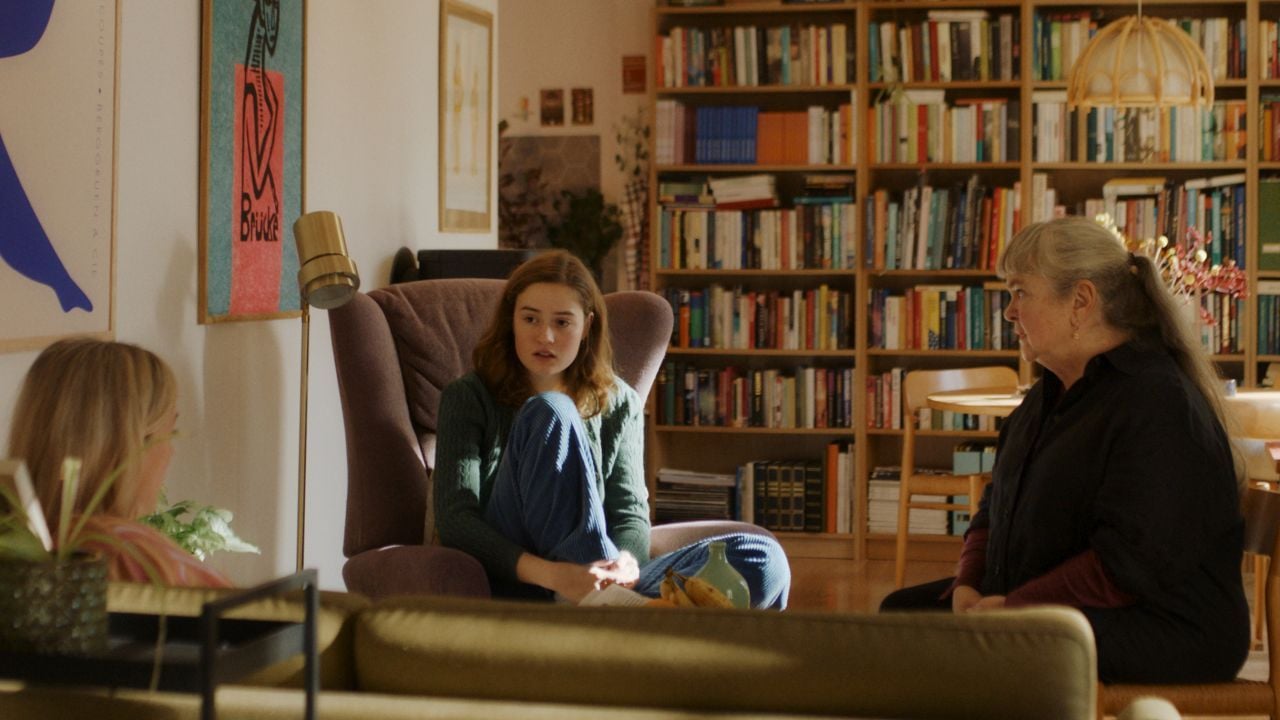
Courtesy of Modern Films.
Three distinct narratives on sexuality make up the "Oslo Stories Trilogy" - each focusing on a different characters and the troubles of each age group whilst maintaining a strong aesthetic that whilst slow perfectly hooks you in to their relatable worlds.
Was it always planned as a trilogy?
Yeah, it was meant to be a trilogy from the start. I wanted to do something different, something I hadn't done before. And I was also thinking about developing a theme in different ways, a theme of sexuality and sexual identity. And I couldn't really understand how I could reflect upon it in different ways in one film. I thought it would be interesting to make more films and also to write different characters and different stories then. And I also wanted to work with a lot of different actors and I couldn't fit them all into one film. As usual, I think that you put some of your early work together as an afterthought and call it the trilogy and I didn't want to do that. I wanted to make three connected films from the start.
Were you very conscious about trying to make all the films different?
I didn't want an audience to think that you're going to get three films that looked and felt very much alike. It would be more interesting to try to do it totally different, as different as possible but then you are working with the same person that I'm writing the script and also working with the same DOP. We really worked very hard to try to get them to look and feel very different.
And was that also an aspect of the kind of different age groups in each film?
I think it's like that regarding due to all the themes, but probably particularly so for sexuality. I think it's different, how you approach sexuality, how you feel about it when you are a teenager, when you are middle-aged, and when you are old. And I think that's also very individual, really, how sexuality works. So you can probably go on and write stories and write characters that deal with it in very different ways.
And what about the location of Oslo? Did you want to focus it in on that as well?
Very much so - because when you choose a location you have a chance to look very closely at it and try to understand it in a way. I'm not from Oslo myself and even if I've been living here for 30 years, there's a lot of many parts of the city I don't really know that well and I don't quite understand either. And I think that's one of the very enjoyable things about making movies that you get the chance to put on some anthropological glasses and to really focus on both location and the people you are trying to tell stories about and society of course and that's what gives meaning to me really and I must say that when you are working that close with location and and have a lot of discussion what to film and what not to film. You end up in lot of dilemmas all the time and I think that's a very interesting part of filmmaking really because it's visual dilemmas in a way, esthetical dilemmas but also moral dilemmas. yeah, I think that's some of the interesting things about filmmaking.
And with the actual aesthetics of the film, there are lot of long takes and long conversation sequences. Why do you think that was key in the trilogy?
I have been working with the same DOP before in two films and then we have both been experimenting with long takes to see how far we can go and to see what kind of aesthetic that lends itself to those kind of scenes reall. And we have been watching a lot of documentaries, more documentaries than fiction I would say, and we both share a very big interest in the works of Frederick Wiseman and how he works with the documentaries.
So that has been there from the start really, to try to figure out different ways of filming long takes, how far we should be from the objects, how much movement it allows. And also, you know, the mise-en-scene, because the movements of the characters, in a way, are making, it's directing the drama, in a way, more than the camera.
With a lot of rehearsals as well beforehand?
Yeah, a lot of rehearsals. That's also a very nice thing to be able to have a lot of rehearsals because then you are getting to know the script very well in different ways and you can also have the time to correct the scripts and to rewrite things and you are working very close with the actors on the script as well, not just instructing the acting, but also discussing the meaning and the different sentences and the different phrasing. You can keep on changing that for a long time, really.
And it seemed very almost natural conversations. Is that something you aim for?
Yeah, these are films that are made in what I would call realistic frames. So it's supposed to feel realistic in a way. I don't think that film dialogue is ever... you can't call it realistic because it's written. But that's we aim for because I think that they need to feel realistic in order to be interesting to think about, I think.
Because it has different ideas, it presents different ideas that I really want the audience to reflect on. And then I think it's easy to do that when it's told in a realistic way and not in a fantasy way or unrealistic way.
And I really like the score as well for each film. How is the music put together?
It was a point to try to use music not just as score, just as something that's going to underscore the feelings or heighten the feelings - but to make it as independent as possible. Because I myself like that very much to be able to just listen while I'm hearing dialogue.
We used the score as that kind of regular film score as well, we had some of those pillar shots. I think, in all the three films are using, presenting the music on its own terms. And it's not only that, of course, because it's also some kind of soundtrack to the images we are looking at, and then the images of the city.
So it's also a way of trying to find out what kind of atmosphere the city gives and what kind of musical atmosphere the city gives. So I was discussing that a lot with the composers, what kind of score we are hearing when we are traveling through the city. And obviously that will always be very individual.Especially for Sex, think that the 80s drum based kind of disco slash yacht rock music was the way we really imagined Oslo.
Yeah. And it's also had a lot of international success. Did you intend it also to have an international viewership?
I don't think you can ever intend that. I think that when you are making films in such a small country as Norway, you have to think about the local or national audience first. But obviously you want it to be, you want to show it to broad as well, but you can't really.
These films have also quite small budgets, so there's not very much money to try to sell it outside of Norway. So I think it's a bit of luck really that those films came to the festival, to the Berlin Festival and that was kind of a luck and then it was from there I think that the distributors picked it up and the sales agent picked it up as well.
How was the funding like? Did you get the funding for the first film or the whole trilogy?
We got the funding for the whole trilogy because this was right after Covid. And then there was a lot of optimism, especially in the streaming channels. And so we went to the Norwegian Film Institute and applied for money and they said that they really liked the idea and they liked the ambition to make three films.
But they could only give us so much money and they said that it would probably be wise if you regard it as a TV series. But we didn't regard it as a TV series, it is a series. But for a streaming service, it doesn't really matter how long an episode is. So when we presented the idea to Viaplay... They had really big ambitions right after COVID. They wanted to make 30 Norwegian TV series. So for them, it was just one of the 30 they were going to make. And then they really looked upon it as a TV series. And then we got an agreement from them that they should premiere in the cinemas. And then they should have the screening window for three months before they had the premiere at the streaming channel. And then we got the money from them and then we started filming and then right after that I think everything closed down at Viaplay.
It kind of links onto that and I'll make it my last question, but what do you think are the benefits of making a trilogy instead of one film and would you do it in the future?
I would absolutely do it in the future. If we had been making it like a TV series, it will be the same characters and same locations for such a long time. But when you are making three different films and you have the same crew, you are starting up three times in a way. At the same time, you are getting to know each other better and better for each film. So it gets easier and easier and it also gets more exciting because you can kind of get tired of the locations and the characters and the story. And then you know to just be patient. In two months, we are going to be in a total different place with different characters, different actors. And it will be fun in another way, hopefully. And I thought it was like that. I'm very good at forgetting all the negatives. So I'm only remembering the positives now, but I think I would... Yeah, I could say that I would really want to do it again.